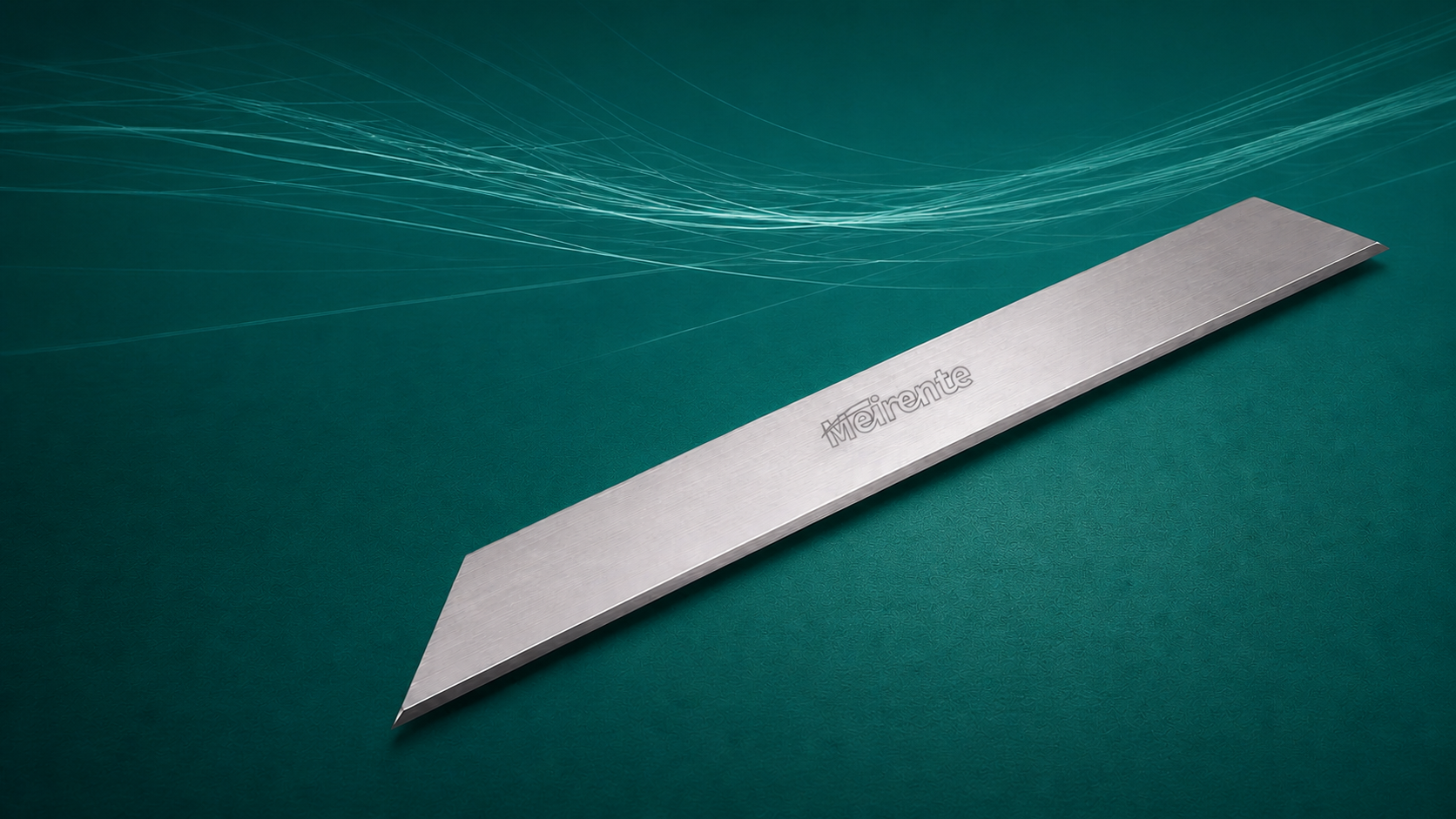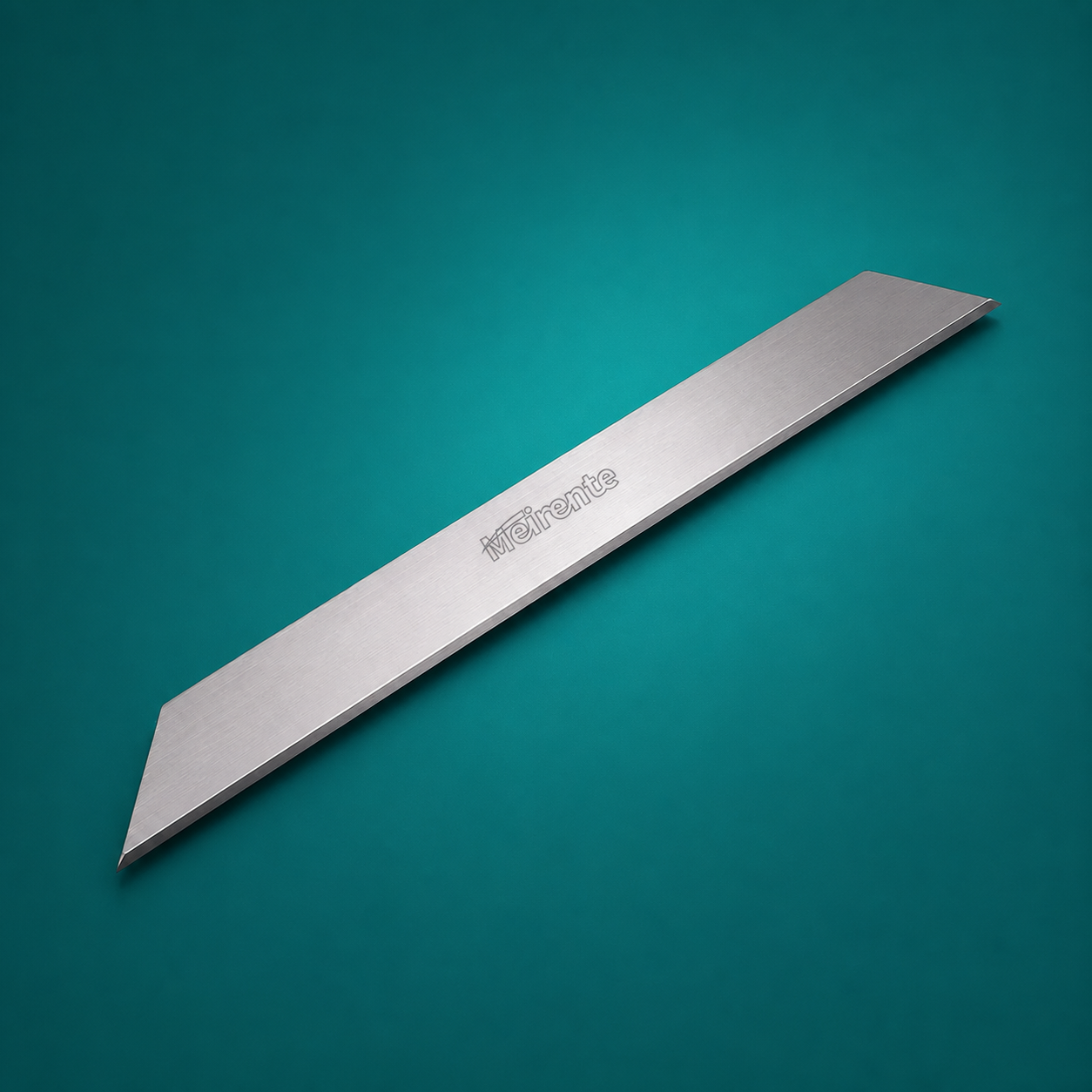
The Meirente G178 × 15.8 × 0.9 mm glass fiber cutting blade is developed for fiberglass processing and chopped strand cutting. Its long precision-ground edge and angled end geometry support sharp fiber separation, repeatable installation, and consistent production quality on compatible cutting equipment.
| Item | Specification |
|---|---|
| Product Type | Glass fiber cutting blade / industrial fiberglass knife |
| Representative Model | G178 × 15.8 × 0.9 mm |
| Length | 178 mm |
| Width | 15.8 mm |
| Thickness | 0.9 mm |
| End Geometry | Angled pointed end, according to approved drawing |
| Edge Type | Precision-ground long cutting edge; bevel confirmed by application |
| Material Options | Wear-resistant tool steel, HSS, or application-specific grades |
| Hardness | Specified according to blade grade and operating conditions |
| Surface Finish | Precision-ground with controlled straightness, flatness, and burr |
| Applications | Fiberglass processing, chopped strand, and compatible fiber cutting |
| Customization | Dimensions, end profile, bevel, material, hardness, finish, coating, and marking |
| OEM / ODM | Supported |
Glass fiber is highly abrasive, so blade material, hardness, edge geometry, surface finish, machine alignment, and cutting load must be reviewed together. Controlled machining, heat treatment for applicable grades, straightness inspection, and final edge grinding help maintain dimensional stability and useful service life.
Standard and custom glass fiber knives are available. For correct selection, provide the existing drawing or sample, dimensions, end geometry, bevel direction, machine model, fiber type, filament or strand details, sizing or binder, line speed, current blade life, and required quantity.
Technical Specifications
Product Detail
The product image below shows the representative long profile, angled pointed end, brushed surface, and continuous precision-ground edge. Final end angle, bevel direction, edge angle, thickness tolerance, straightness, and holder-fit requirements must follow the approved drawing.
Product Features
Precision-ground fiber edge: Supports sharp separation and controlled strand length on compatible cutting systems.
Angled end geometry: End profile can support holder fit and cutting engagement when manufactured to the approved drawing.
Stable dimensional control: Straightness, thickness, and profile inspection support repeatable replacement performance.
Wear-resistant grade options: Blade material, hardness, finish, and optional coating can be reviewed against fiber composition, sizing, speed, and blade-life target.
OEM and ODM manufacturing: Custom dimensions, profiles, edges, materials, coatings, marking, inspection, and packaging are available.
Related Glass Fiber Blade Models
Typical Applications
Chopped glass fiber strand production and cutting lines
Fiberglass processing and reinforced-material preparation
Continuous strand cutting with a model selected for the machine geometry
Fiber chopping drums, holders, and custom cutting assemblies
Drawing-based replacement knives for glass fiber processing equipment
Quality Control
Incoming material grade and batch verification
Length, width, thickness, end angle, profile, and position inspection
Straightness, flatness, parallelism, and holder-fit checks according to drawing
Edge angle, bevel direction, edge finish, burr, and micro-chipping inspection
Heat-treatment and hardness verification for applicable blade grades
Rust prevention, edge protection, traceable labeling, and export packing inspection
Custom Manufacturing Options
Installation and Safety Notes
Lock out the cutting machine before removing, cleaning, inspecting, or installing the blade.
Use cut-resistant gloves, eye protection, and site-required fiber/dust protection during handling.
Clean the holder, clamp, locating surfaces, spacers, and fasteners before installation.
Confirm blade dimensions, end orientation, installation face, bevel direction, and cutting direction.
Use even clamping force and verify that the blade sits straight without trapped fiber or local stress.
Check cutter alignment, overlap, clearance, drum condition, vibration, and extraction before full-speed operation.
Inspect the edge for wear, chipping, bending, or fiber buildup and follow the site's approved disposal procedure.
RFQ Checklist
Existing blade drawing, sample, or clear dimensioned photos
Length, width, thickness, end angle, bevel direction, edge angle, and tolerances
Machine brand, model, holder geometry, cutter diameter, blade quantity, and operating speed
Glass fiber type, filament diameter, strand count, sizing or binder, moisture, and throughput
Required cut length, current blade material, service life, and failure mode
Quantity, delivery destination, inspection, certificate, marking, and packing requirements
Frequently Asked Questions
Q1. Is the G178 × 15.8 × 0.9 mm model available as a custom blade?
Yes. Dimensions, end profile, bevel, material, hardness, finish, coating, marking, inspection, and packaging can be manufactured from an approved drawing or sample.
Q2. Which material is recommended for glass fiber cutting?
The correct grade depends on glass composition, sizing, strand structure, machine speed, edge geometry, impact load, and target blade life. Wear-resistant tool steel, HSS, and application-specific grades can be reviewed.
Q3. Can you manufacture from an old blade sample?
Yes. Mark the installation face, working edge, and cutting direction. Photos of the blade holder and the current wear or chipping condition improve the engineering review.
Q4. Are coatings available?
Suitable wear-resistant coatings may be available after reviewing the base material, edge finish, glass fiber composition, sizing, impact load, operating temperature, and cleaning method.
Q5. How can premature blade wear be reduced?
Confirm blade grade, hardness, edge geometry, holder alignment, cutting clearance, strand feed, contamination, and machine vibration. The worn blade should be examined before changing only one parameter.
Q6. Are sample orders available?
Sample orders can be arranged for eligible standard or custom models so fit, cutting quality, strand length, wear pattern, and service life can be evaluated before a larger order.
Q7. What is the production lead time?
Lead time is confirmed after the drawing, material, tolerances, heat treatment, coating, quantity, inspection documents, and packing requirements have been reviewed.
| Article Number | G178 × 15.8 × 0.9 mm |
|---|---|
| Model | G178 × 15.8 × 0.9 mm |
| Measurements | Length: 178 mm Width: 15.8 mm Thickness: 0.9 mm |
| Material | Wear-resistant tool steel, HSS, or application-specific grades |
| Service | Dimensions, end profile, bevel, material, hardness, finish, coating, and marking |